
Flag

We stand with Ukraine and our team members from Ukraine. Here are ways you can help

Get exclusive access to thought-provoking articles, bonus podcast content, and cutting-edge whitepapers. Become a member of the UX Magazine community today!

Home ›› Business Value and ROI ›› 6 Key Questions to Guide International UX Research ›› Announcing the Drawing Ideas Contest Winners

Announcing the Drawing Ideas Contest Winners

by UX Magazine Staff, Mark Baskinger
1 min read
Share this post on
Tweet
Share
Post
Share
Email
Print

Save

Two sketches and a video for the winners of our Drawing Ideas book contest.

In December, we announced a contest to win a copy of Drawing Ideas: A hand-drawn approach for better design, the new book by Mark Baskinger and William Bardel. Entries were requested in the form of design drawing challenges. Along with a copy of the book and a UI Stencil, two winners were also promised some sketches of their entries.

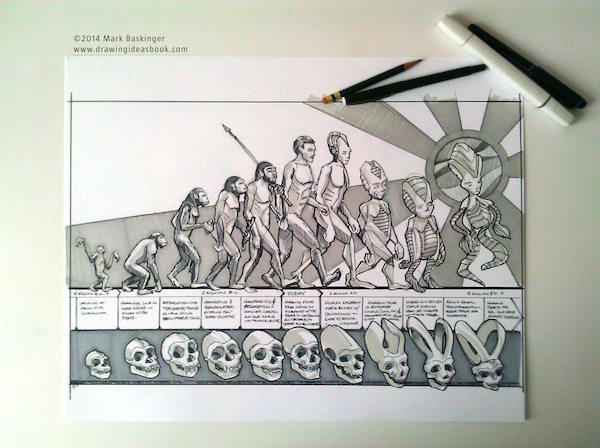
The first winning entry came from Paul Brooks, a UX designer in the United Kingdom, who posed this challenge on Twitter: “Continue the ‘Evolution of Man’ image, looking forward one million years.”
parallax scrolling

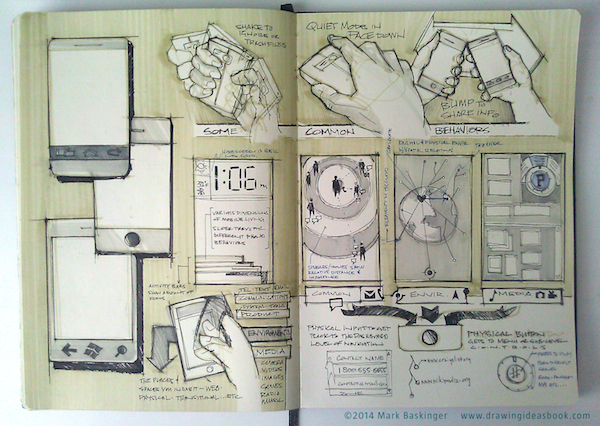
The other winning challenge came from Rebecca R who requested, “A responsive, graphic centered design that’s intuitive across mobile devices—Apple, Android, and Windows.”
parallax scrolling

“This rough sketch captures my initial thinking on the fly as I try to figure out what a cross-platform, graphic-centered phone UI might be,” Baskinger says. “Whenever I sketch digital interfaces, I try to connect them to both physical hardware and behaviors to think through the user experience more holistically. To keep the mobile experience simple, this concept focuses on four key platform-independent attributes: communications (telephone, text, email), product/system (controls, tools, setup, etc), environments (physical places, GPS, bookmarked web pages, browser, social media, etc), and digital media (photos, videos, music, radio, etc).”

Here’s a video of Baskinger completing the sketch:

Last but not least, check out our video flip-though of Drawing Ideas:

post authorUX Magazine Staff

UX Magazine Staff
UX Magazine was created to be a central, one-stop resource for everything related to user experience. Our primary goal is to provide a steady stream of current, informative, and credible information about UX and related fields to enhance the professional and creative lives of UX practitioners and those exploring the field. Our content is driven and created by an impressive roster of experienced professionals who work in all areas of UX and cover the field from diverse angles and perspectives.

post authorMark Baskinger

Mark Baskinger

Mark Baskinger is an associate professor in the School of Design at Carnegie Mellon University who teaches courses in industrial design with an emphasis on form & interaction. His interests include exploring new paradigms for interactive objects and interpretive environments, and methodologies of design drawing and visual thinking to promote collaboration. He has published papers and articles on the language of designed artifacts, inclusive/universal design, visual “noise” in product design, tangible interaction, and methodologies of visualization.

Baskinger currently serves as a researcher with the Quality of Life Technology Engineering Research Center through Carnegie Mellon University and the University of Pittsburgh; he is a core faculty member in the Master of Tangible Interaction Design program through Carnegie Mellon’s School of Architecture (mTID), is an affiliate faculty member of the Human-Computer Interaction Institute (HCII) at Carnegie Mellon and collaborates with the /d.search-labs at the Technische Universiteit Eindhoven, The Netherlands (TU/e).

An international speaker and workshop leader, Mark also conducts Drawing Ideas®: A Field Guide to Visual Thinking courses in conference and business contexts where he makes design drawing methods and visual thinking techniques accessible to a broader audience and demonstrates strategies for using sketching to foster collaboration in design processes. His work has been featured in design publications and international magazines, and has been exhibited in numerous galleries and museums, including the Museum of Modern Art (New York), I-Space Gallery (Chicago), the Krannert Museum (Illinois) and the Regina Gouger Miller Gallery (Pittsburgh). His work is also included in the permanent art collection of the University of Illinois.

He has won numerous design awards from ID Magazine and the Industrial Designers Society of America (IDEA) and personally holds multiple product patents. Prior to joining Carnegie Mellon, Baskinger was creative director at Corchia Woliner Rhoda in New York City, and was the lead designer at the Central Park Zoo - Exhibits and Graphic Arts Dept. He also held a visiting faculty position in the School of Art and Design (https://art.uiuc.edu) at the University of Illinois (UIUC). Parallel to his appointment at Carnegie Mellon, he co-directs The Letter Thirteen Design Agency, and is a founding member of the EcoDesigners Guild of Pittsburgh.

Tweet
Share
Post
Share
Email
Print

Related Articles

Forget linear workflows — today’s creative process is dynamic, AI-assisted, and deeply personal. Learn how to build a system that flows with you, not against you.

Article by Jim Gulsen
The Creative Stack: How to Thrive in a Nonlinear, AI-Assisted World
  • The article explores the shift from linear to nonlinear, AI-assisted creative workflows.
  • It shares practical ways to reduce friction and improve flow by optimizing tools, habits, and environments.
  • It argues that success comes from designing your own system, not just using more tools.
Share:The Creative Stack: How to Thrive in a Nonlinear, AI-Assisted World
7 min read

How is AI really changing the way designers work, and what still depends on human skill? This honest take cuts through the hype to show where AI helps, where it falls short, and what great design still demands.

Article by Oleh Osadchyi
The Real Impact of AI on Designers’ Day-To-Day and Interfaces: What Still Matters
  • The article explores how AI is reshaping designers’ workflows, offering speed and support across research, implementation, and testing.
  • It argues that while AI is useful, it lacks depth and context — making human judgment, critical thinking, and user insight indispensable.
  • It emphasizes that core design principles remain unchanged, and designers must learn to integrate AI without losing their craft.
Share:The Real Impact of AI on Designers’ Day-To-Day and Interfaces: What Still Matters
9 min read

What if you could build software just by talking to your computer? Welcome to vibe coding, where code takes a back seat and the vibe leads.

Article by Jacquelyn Halpern
Vibe Coding: Is This How We’ll Build Software in the Future?
  • The article introduces vibe coding, using AI to turn natural language into working code, and shows how this approach lets non-coders build software quickly and independently.
  • The piece lists key tools enabling vibe coding, like Cursor, Claude, and Perplexity, and notes risks like security, overreliance on AI, and the need for human oversight.
Share:Vibe Coding: Is This How We’ll Build Software in the Future?
7 min read

Join the UX Magazine community!

Stay informed with exclusive content on the intersection of UX, AI agents, and agentic automation—essential reading for future-focused professionals.

Hello!

You're officially a member of the UX Magazine Community.
We're excited to have you with us!

Thank you!

To begin viewing member content, please verify your email.

Tell us about you. Enroll in the course.

    This website uses cookies to ensure you get the best experience on our website. Check our privacy policy and